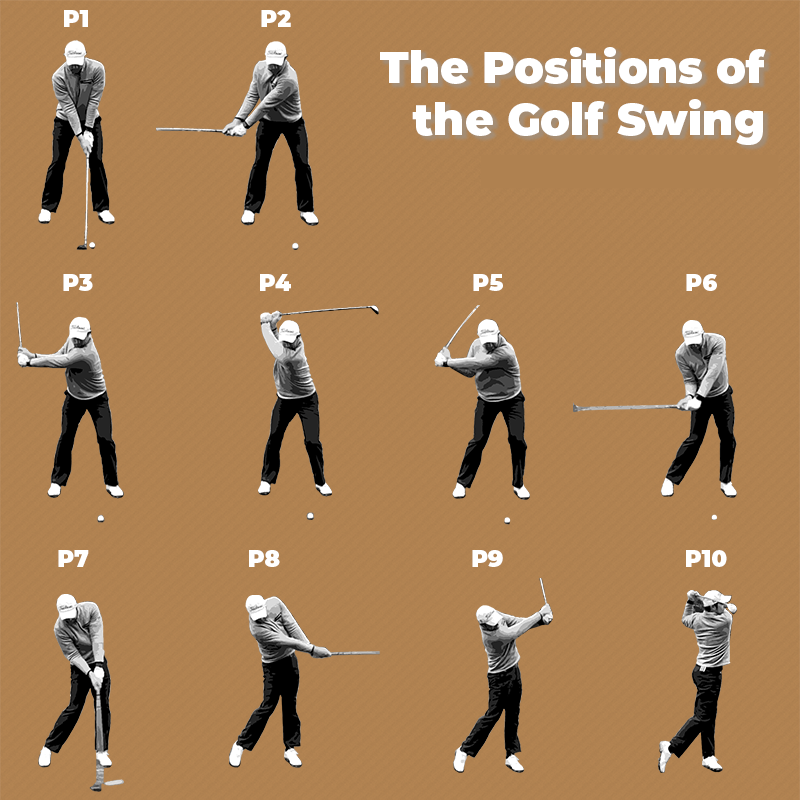
Knowing how to isolate or compartmentalize different parts of the swing is important. This allows you to measure any changes that are/have been made and also helps isolate a part of the swing to make it easier to comprehend and learn. If you can learn and compartmentalize these areas, then layer them on top of one another (essentially chunking them together) the whole thing is easier to learn. The long and the short of it is this, there are 10 positions widely used in the teaching world as a way of measuring the effectiveness of a golf swing. The shorthand for these positions are P1 through P10. This page details these 10 positions using the side and back views of Rory McIlroy’s swing to illustrate each position. Follow along below at each step to see why Rory compresses his iron shots so well and hits drives well over 300 yards. Since Rory is right handed, his lead arm is his left arm and his trail arm is his right arm. This is the opposite for left hand players. I do my best to explain this for each position.
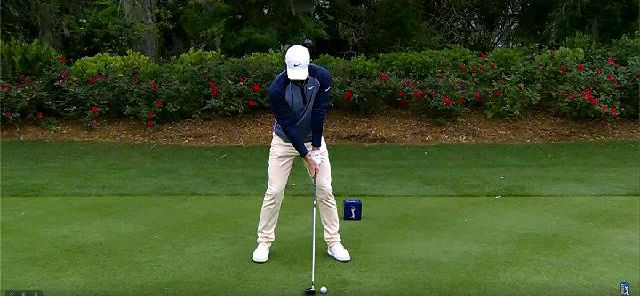
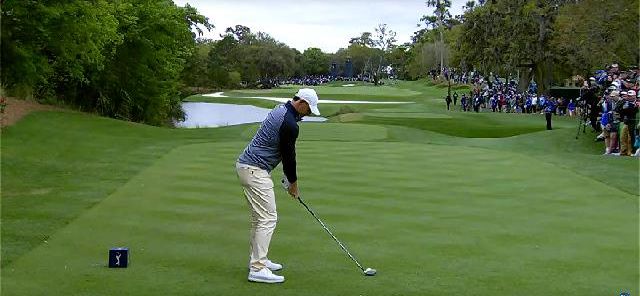
P1: Address
- Feet approximately shoulder-width apart, providing a stable, athletic base
- Lead foot slightly flared toward the target to facilitate rotation through impact
- Knees softly flexed rather than deeply bent
- Hinge forward from the hips while maintaining a relatively neutral spine
- Pressure balanced through the feet, generally through the mid-foot rather than excessively toward the toes or heels
- Trail shoulder slightly lower than the lead shoulder, primarily because the trail hand is lower on the grip
- Head centered between the shoulders and, with longer clubs, slightly behind the ball
- Arms hanging naturally from the shoulders without reaching for the club
- Hands relaxed and typically several inches from the thighs, allowing the arms room to swing
- With an iron, hands may be slightly ahead of the ball; the exact position varies with club and ball position
- Grip pressure light enough to avoid unnecessary tension while maintaining control of the club
Alignment
At address, the feet, knees, hips, and shoulders should generally be aligned parallel to the intended target line for a neutral shot. Because the golfer stands to the side of the ball, these body lines appear slightly left of the actual target for a right-handed golfer—the familiar “railroad tracks” concept.
Good players devote considerable attention to setup because the address position establishes the conditions from which the swing begins. A stable stance, appropriate posture, balanced pressure, and consistent alignment make it easier for the body and club to move efficiently throughout the swing.
A slightly flared lead foot can make it easier for the pelvis to rotate toward the target during the downswing and through-swing. Appropriate stance width provides stability while still allowing the hips and torso to rotate freely. The goal is not to create a rigid position, but an athletic, balanced starting position from which the golfer can move.
P2: Coordinated Takeaway — First Parallel
The coordinated takeaway begins at address and continues until the club shaft is approximately parallel to the ground—the position commonly called P2 or “first parallel.”
“Coordinated” does not mean that every body part moves the same amount. Rather, the takeaway is produced by a blended movement of the chest, shoulders, arms, pelvis, and legs, with the upper body turning more than the pelvis. The arms and club remain connected to the rotation of the torso instead of independently pulling the club behind the body.
During an efficient takeaway, the chest begins rotating away from the target while the pelvis also begins to turn. The lead shoulder works down and inward, while the trail shoulder works back and somewhat upward. At the same time, the trail hip begins moving back behind the golfer rather than sliding laterally away from the target.
The goal is to arrive at P2 with the golfer still centered and balanced, the club in front of the body, and the body already beginning the rotational and tilting movements that will continue into the backswing.
Checkpoints at P2
- Chest, shoulders, arms, pelvis, and legs have all participated in the takeaway
- Shoulders have turned more than the hips; the body is coordinated but not moving as one rigid unit
- Lead arm remains relatively straight and extended without becoming rigid
- Trail arm remains relatively long but may begin to soften or flex
- Hands remain generally in front of the chest rather than being pulled behind the body
- Lead shoulder moves down and inward while the trail shoulder moves back and upward
- Trail hip moves back and around rather than sliding away from the target
- Lead knee begins to gain flex while the trail knee may begin to lose some flex
- Club shaft is approximately parallel to the ground and generally parallel to the target line
- Clubface remains relatively matched to the golfer’s inclination/spine angle rather than being dramatically rolled open
- Head remains relatively centered while allowing the body to rotate naturally
Avoid the Trail-Side Sway
A common fault, particularly among beginning golfers, is to sway away from the target during the takeaway. The trail knee, trail hip, and sometimes the head move laterally rather than allowing the pelvis to rotate.
This can move pressure toward the outside of the trail foot and make it more difficult to rotate properly, complete the backswing, and subsequently move toward the lead side during the downswing.
Instead, feel the trail hip moving back behind you as the pelvis begins to rotate. The lead knee can increase slightly in flex and move inward as the lead side of the pelvis lowers. The torso combines rotation with side bend, allowing the golfer to turn while remaining relatively centered.
A useful setup drill for golfers who have a strong tendency to sway is to begin with slightly more pressure on the lead foot—for example, approximately 55–60% lead / 40–45% trail. This is a drill or feel rather than a requirement for every golfer. During the backswing, pressure can move into the trail foot even though the golfer’s upper body remains relatively centered.
P3: Lead Arm Parallel to Ground
From P2, the coordinated takeaway develops into the backswing as the chest and shoulders continue rotating, the pelvis continues to turn, the arms begin moving upward, and the wrists begin to hinge.
The P3 position is reached when the lead arm is approximately parallel to the ground. By this point, the golfer has developed considerably more upper-body rotation while the pelvis has turned a smaller amount. The trail hip continues moving back and around, allowing the golfer to remain relatively centered rather than swaying away from the target.
The arms remain connected to the rotation of the torso, but they are no longer simply moving around the body. They are also beginning to move upward, while the trail elbow folds and the wrists begin setting the club.
Checkpoints at P3
- Lead arm is approximately parallel to the ground
- Chest and shoulders have continued rotating away from the target
- Pelvis has continued turning, but less than the upper torso
- Lead arm remains relatively straight and extended without becoming rigid
- Trail elbow has begun to fold while remaining reasonably close to the body
- Hands remain generally in front of the chest rather than disappearing behind the torso
- Lead shoulder continues moving down and inward as the trail shoulder moves back and upward
- Lead knee gains some flex and can move slightly inward
- Trail hip continues moving back and around behind the golfer
- Trail leg may lose some flex as the pelvis turns
- Wrists have begun to hinge, creating an increasing angle between the lead arm and club shaft
- Club shaft is generally on an appropriate plane, with the butt end of the club pointing somewhere near the ball/ball-target line
- Head remains relatively centered while allowing some natural movement
P4: Top of the Backswing
P4 represents the completion of the backswing and the beginning of the transition into the downswing. Unlike P2 and P3, P4 is not defined by the club reaching a specific relationship to the ground. Some golfers reach parallel, some stop short of parallel, and others may go slightly beyond it.
As the golfer moves from P3 to P4, the chest continues rotating, the arms continue gaining elevation, the trail elbow folds, and the wrists continue setting the club. The pelvis continues to turn, but considerably less than the upper torso. Meanwhile, the trail hip continues moving back and around rather than laterally away from the target.
The golfer reaches P4 in a fully turned but dynamically balanced position, ready to reverse direction and begin the downswing.
Checkpoints at P4
- Chest and shoulders have completed most of their backswing rotation
- Pelvis has rotated away from the target, but less than the upper torso
- Lead arm remains relatively straight and extended without becoming rigid
- Trail elbow is flexed and generally remains in a functional relationship with the torso
- Hands have gained both height and depth while remaining connected to the body’s rotation
- Wrists are substantially hinged/set
- Trail wrist is extended or “bent back,” while the lead wrist is generally flat to slightly flexed depending upon the golfer’s grip and swing pattern
- Lead shoulder has moved down, inward, and around as the chest has rotated
- Trail side has lengthened as the golfer rotates and side-bends
- Lead knee has gained flex and may move inward toward the trail side
- Trail knee has generally lost some flex
- Trail hip has moved back, around, and somewhat higher as the pelvis turns
- Pressure has increased substantially under the trail foot, while the golfer remains relatively centered rather than swaying
- Head remains relatively centered, although some natural movement is acceptable
- Club position at the top varies considerably among successful golfers and does not need to reach parallel to the ground
Rotation + Side Bend + Extension
Notice the folds or wrinkles in the front of Rory’s shirt. Rather than thinking of the backswing as simply “turning around the spine,” recognize that the torso is undergoing a three-dimensional combination of rotation, side bend, and extension.
During the backswing, the lead side of the torso shortens as the golfer develops lead-side bend, while the trail side lengthens. At the same time, the golfer rotates away from the target and the upper torso gradually extends relative to its address inclination.
These combined movements allow the golfer to make a substantial turn while remaining relatively centered over the ball.
At P4, the golfer has created a powerful position from which the body can change direction. However, the body is not simply a tightly wound spring that must “uncoil.” The downswing will involve a coordinated change of direction beginning with changes in pressure and movement of the lower body while the upper body and club are still completing their backswing motion.
P5: Transition — Lead Arm Parallel
The transition is the brief change of direction between the backswing and downswing. It begins as the golfer approaches P4 and continues into the early downswing. P5 is reached when the lead arm is approximately parallel to the ground on the downswing.
Although the transition may appear to begin with the arms and club moving downward, an efficient transition is strongly influenced by changes occurring from the ground up. Pressure begins moving rapidly toward the lead foot, the pelvis begins changing direction and rotating toward the target, and the arms and club respond while also making their own coordinated movements.
Importantly, these movements overlap. The lower body can begin changing direction while the arms and club are still completing their backswing. There is no distinct stop at P4 followed by a separate downswing.
Checkpoints approaching and reaching P5
- Pressure shifts rapidly from the trail side toward the lead foot
- Lead knee moves toward the target and remains flexed during the early transition
- Pelvis begins shifting slightly toward the target while simultaneously beginning to rotate open
- Lead hip begins moving back and around as the pelvis rotates
- Pelvis may lower slightly as both legs temporarily gain flex
- Chest begins changing direction after the lower body has initiated its transition
- Arms begin lowering while remaining coordinated with the rotation of the torso
- Trail elbow begins moving down and in front of the trail side
- Lead arm remains relatively straight and reaches approximately parallel to the ground at P5
- Trail wrist retains considerable extension while the club remains hinged relative to the arms
- Club begins shallowing naturally in many accomplished swings rather than being forced steeply downward from the top
- Head remains relatively stable while allowing natural movement
- Pressure is predominantly moving toward the lead side, preparing the golfer to rotate through impact
The Transition Is a Sequence, Not a Single Move
A useful way to understand transition is as an overlapping sequence of movements rather than simply “starting the downswing with the hips.”
As the backswing is finishing, pressure begins moving toward the lead foot. The pelvis begins changing direction, followed by the torso, arms, and ultimately the club. Because the club has greater distance to travel and responds to the motion of the golfer, it initially appears to remain behind while the body begins moving toward the target.
This creates the characteristic sequencing seen in powerful golf swings without requiring the golfer to consciously “hold” the club back or manufacture lag.
P6: Last Parallel
P6 is reached when the club shaft is approximately parallel to the ground during the downswing, sometimes called “last parallel.” By this point, the transition is largely complete and the golfer is rapidly approaching impact.
Pressure has moved strongly toward the lead side, the pelvis is continuing to rotate open, and the lead hip is moving back and around to create space for the arms and club. The chest is also rotating toward the target but generally remains less open than the pelvis.
The arms have lowered in front of the body, the trail elbow has moved down and in front of the trail hip, and the wrists retain much of their angles. From this position, the golfer can continue rotating while the arms, wrists, and club progressively release toward impact.
Checkpoints at P6
- Club shaft is approximately parallel to the ground
- Pressure is predominantly under the lead foot
- Pelvis has shifted toward the target and rotated open
- Lead hip is moving back and around, creating room for the arms and club
- Chest is beginning to open toward the target but generally trails the rotation of the pelvis
- Trail elbow has moved down and in front of the trail hip rather than becoming trapped behind the body
- Hands have lowered into the area near the trail thigh
- Trail wrist retains considerable extension or “bend back”
- Lead wrist is generally flat or somewhat flexed, depending on the golfer’s grip and swing pattern
- Club shaft has moved onto a functional delivery plane without being deliberately forced behind the golfer
- Clubhead remains behind the hands as the club approaches impact
- Lead leg is beginning to extend as the lead hip continues moving back and around
- Trail heel may begin lifting as pressure leaves the trail foot
- Head remains relatively stable and generally behind the ball, particularly with longer clubs
From P6 to Impact — Rotation and Release
P6 is an important delivery position, but it should not become a position the golfer consciously tries to hold.
From P6, the pelvis and chest continue rotating toward the target while the lead hip moves back and the lead leg increasingly extends. At the same time, the arms continue moving toward the ball and the wrists begin releasing the club.
The clubhead now accelerates rapidly as the golfer converts the movements established earlier in the downswing into clubhead speed.
The objective is not to hold the wrist angles as long as possible. Rather, the golfer maintains the wrist conditions long enough for the club to arrive at P6 in a good delivery position and then allows the club to release naturally through impact.
The last parallel position is an important checkpoint in the golf swing. When practicing stop your swing there and check to ensure you’ve reached this position correctly. If you haven’t, the results of the remainder of your swing is in jeopardy. Supination and pronation of the wrists are somewhat complex subject to discuss here, but a full explanation and illustration can be found at this link.
P7: Impact
P7 is the moment the clubhead contacts the ball. Impact occurs extremely quickly and should be viewed primarily as the result of the movements and sequencing that occurred earlier in the swing, rather than as a position the golfer tries to manufacture.
As the golfer moves from P6 into impact, the pelvis and chest continue rotating open, the lead hip moves back and around, and the lead leg extends. The arms continue moving and the wrists progressively release the club, producing the tremendous increase in clubhead speed that occurs approaching impact.
Importantly, the club has not completely released at P7. With an iron, the hands normally arrive ahead of the clubhead and the trail wrist retains some extension. The club continues releasing through and beyond impact.
Checkpoints at P7
- Pressure is predominantly under the lead foot
- Lead hip has moved back and around and the pelvis is open to the target line
- Chest is also open, although generally less open than the pelvis
- Lead leg has substantially extended and provides a strong lead-side support
- Trail heel is rising as pressure leaves the trail foot
- Hands are generally ahead of the ball with an iron, producing forward shaft lean
- Trail wrist retains some extension or “bend back”
- Lead wrist is generally flat or somewhat flexed, depending upon the golfer’s grip and swing pattern
- Trail elbow remains somewhat flexed but is moving toward extension
- Lead shoulder is moving up, back, and around
- Trail shoulder is moving down, forward, and around
- Clubface is delivered approximately square to the intended starting direction
- Head remains generally behind the ball while the body continues rotating toward the target
- With an iron, the clubhead is still traveling downward at impact and reaches its low point after the ball
P8: Post-Impact — Shaft Parallel
P8 is reached when the club shaft is approximately parallel to the ground after impact. From P7 to P8, the golfer continues rotating through the shot while the arms extend and the club progressively releases.
The clubhead does not travel straight toward the target. Instead, it continues along its curved swing arc—moving forward, upward, and increasingly inward as the body rotates toward the finish.
By P8, the ball is long gone. The golfer’s objective is not to manipulate the club after impact, but to allow the movements established earlier in the downswing to continue naturally through the strike.
Checkpoints at P8
- Pressure remains predominantly on the lead foot
- Lead hip continues moving back and around as the pelvis rotates toward the target
- Pelvis is substantially open and beginning to rise as the lead leg extends
- Chest has continued rotating and is increasingly open toward the target
- Lead shoulder continues moving up, back, and around
- Trail shoulder continues moving forward and around
- Both arms are considerably more extended than they were at impact
- Trail elbow has continued extending after being flexed at P7
- Hands and grip move away from the body as the arms extend through the strike
- Wrists and forearms continue releasing naturally rather than being consciously “rolled over”
- Club shaft reaches approximately parallel to the ground after impact
- Clubhead is moving upward and inward along the swing arc
- Lead leg is substantially extended
- Trail heel continues rising as the trail foot rolls onto the toe
- Golfer maintains dynamic balance while continuing to rotate toward the finish
- Head begins to rotate naturally toward the target as the body moves into the follow-through
P9: Follow-Through — Lead Arm Parallel
P9 is reached when the lead arm is approximately parallel to the ground during the follow-through. By this point, the ball is well on its way and the movements occurring at P9 are the continuation and completion of the forces and motions generated earlier in the swing.
From P8 to P9, the club continues moving upward, inward, and around the body as the golfer rotates and extends toward the finish. The pelvis and chest continue turning toward the target, the lead hip moves back and upward, and the trail side continues rotating through.
The arms, wrists, and club continue their natural release and begin folding into the follow-through. The golfer is no longer trying to propel the club toward the target; momentum and continued body rotation carry the club around and upward toward the finish.
Checkpoints at P9
- Lead arm is approximately parallel to the ground
- Pressure is almost entirely supported by the lead side
- Lead hip has continued moving back, around, and upward
- Pelvis is substantially rotated toward the target
- Chest has continued rotating and is facing increasingly toward the target
- Lead leg is extended and provides support for the golfer’s rotating body
- Trail knee moves toward the lead knee as the trail side rotates through
- Trail heel is well off the ground with the trail foot moving onto its toe
- Arms have begun folding naturally after their extension through P8
- Hands and club continue moving upward and around the body
- Lead elbow begins folding while the trail arm remains relatively long
- Lead shoulder continues moving up, back, and around
- Trail shoulder has moved down, through, and around and is now substantially closer to the target than it was at address
- Torso and pelvis continue extending toward the finish
- Head and eyes are free to rotate naturally toward the target
- Golfer remains balanced over the lead side
P10: Balanced Finish
P10 is the completion of the golf swing. From P9 to P10, the body’s rotation and momentum carry the golfer into a fully rotated, extended, and balanced finish.
At P10, the chest and pelvis have rotated toward the target, the body has risen out of its forward-bent address posture, and the golfer is supported almost entirely by the lead leg. The trail foot has rolled onto its toe and the arms and club have folded naturally around the body.
A balanced finish is an important indicator of an efficiently sequenced swing. The golfer should be able to hold the finish comfortably for several seconds without falling forward, backward, or stepping to regain balance.
Checkpoints at P10
- Pressure and body support are predominantly over the lead side
- Lead leg is extended and supports the golfer in a tall, balanced position
- Pelvis has fully rotated toward the target
- Chest has rotated through and generally faces the target or slightly left of it for a right-handed golfer
- Lead hip has moved back, around, and upward
- Trail knee has moved toward the lead knee
- Trail heel is fully raised with the golfer balanced on the trail toe
- Sole of the trail shoe generally faces away from the target
- Arms have folded naturally and the club has wrapped around the body
- Hands finish high and around the lead shoulder, although exact finish height varies among golfers
- Torso is extended and tall rather than remaining bent forward in the address posture
- Some trail-side bend may remain depending upon the golfer and the shot
- Head and eyes have rotated naturally toward the target
- Golfer can comfortably hold the finish without losing balance
The Finish Is the Result, Not the Objective
A balanced P10 does not guarantee that every previous position was technically perfect. Golfers can make compensations during the swing and still arrive at an attractive finish.
However, the finish provides valuable information about the movements that preceded it. A golfer who repeatedly falls forward, hangs back on the trail foot, steps out of the shot, or cannot hold the finish may have problems with pressure shift, rotation, sequencing, or balance earlier in the swing.
Rather than trying to manufacture a picture-perfect P10, use the finish as a diagnostic:
Can I finish completely on my lead side, fully rotated, tall, and balanced—and comfortably hold that position?
If so, many of the movements leading into the finish were probably working reasonably well.